

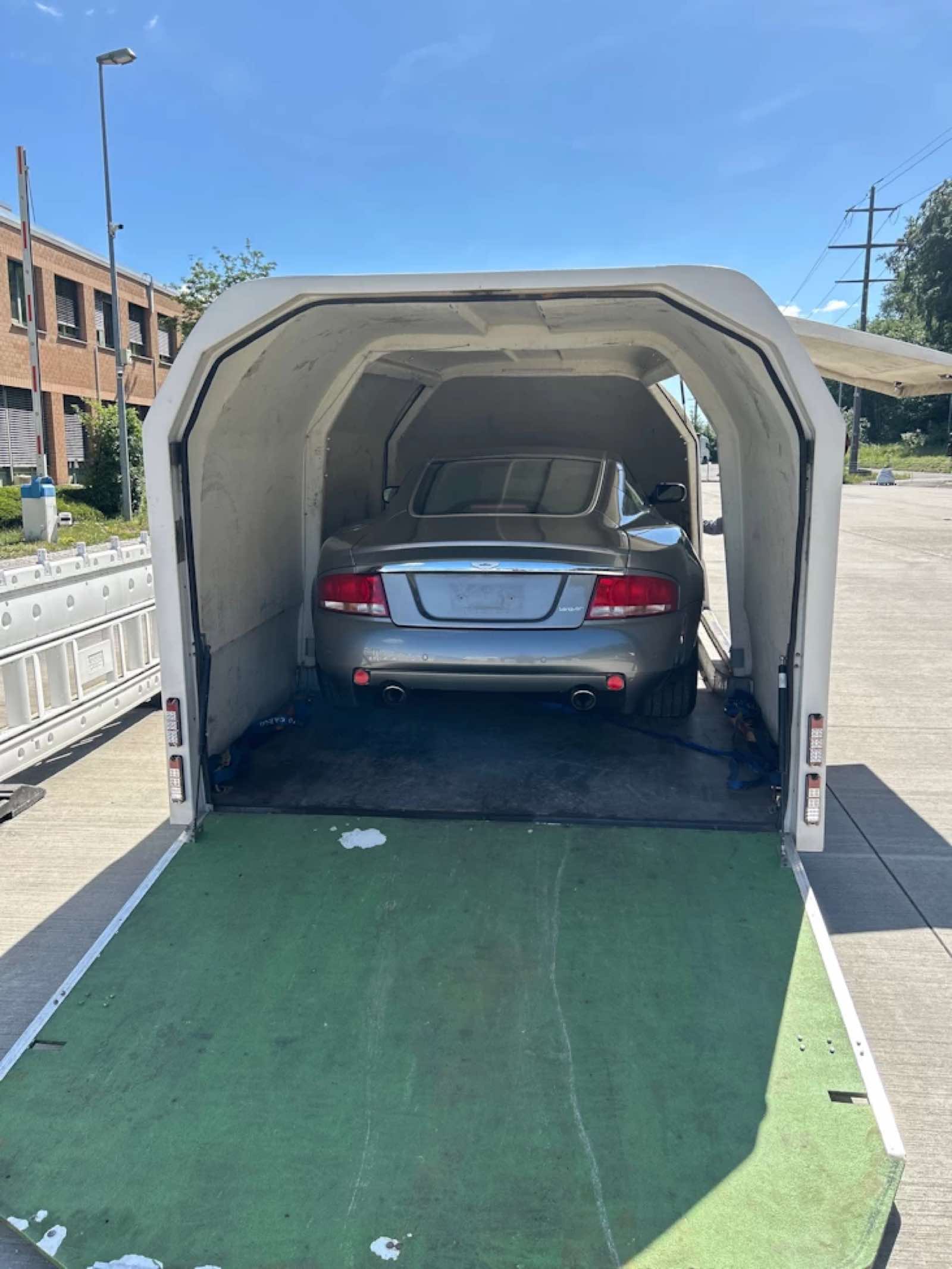
 Photo: Zoll.de
Aston Martin entering the EU without a T1: €19,200 on the spot and a criminal investigation
By Paul Coenen, LL.M.
In mid-June a 52-year-old Dutch national attempted to bring an Aston Martin into the EU from Switzerland. The car was on a trailer. At the Zollamt Bietingen he was stopped and asked for his customs documents. He had none.
His explanation: the client had purchased the car in Switzerland, and customs clearance was to take place in the Netherlands. That is permitted. Just not the way he went about it. He was required to pay €19,200 on the spot — by emergency bank transfer, before he was allowed to continue — on a vehicle valued at approximately €62,000. And it did not stop there.
In brief
- Clearing customs in the Netherlands is permitted, but the goods must be declared at the border at the latest under a T1 document, with a security deposit.
- The €19,200 is not just import duty: it includes import VAT. Via the Netherlands, expect roughly 33% of the customs value, not 10%.
- With a proper declaration the duties would have been exactly the same. The missing document did not trigger extra tax — only a criminal file.
- An old purchase invoice is often not the customs value — not because you are allowed to disregard it, but because it was never the legal basis in the first place.
- Classic cars may qualify under CN heading 9705: 0% import duty and 9% VAT. Age alone is not enough; seven criteria apply.
What exactly went wrong?
The Hauptzollamt Singen explains the rule: an importer may choose whether to clear customs at the border or at the competent inland customs office. If the latter, this must be declared at the border at the latest, and a security deposit must be lodged.
The driver was therefore correct that clearance in the Netherlands was allowed. He simply lacked the document that makes it possible. A car that crosses the external border without a declaration is considered to have been removed from customs supervision; intent does not need to be proven.
A Steuerstrafverfahren (tax criminal investigation) was opened against him for tax evasion, which — after transfer to the Hauptzollamt Karlsruhe — continues while the car has long been in the Netherlands. That is the part that lingers: the duties were owed regardless, so the missing document did not produce a single euro of extra tax — only a file.
What is a T1 and when do you need one?
A T1 is the declaration for external Union transit: the document under which non-Union goods travel through the EU under customs supervision without the duties becoming payable. The goods travel uncleared, under suspension of import duties, with a security deposit and the obligation to present them at the office of destination in time and unaltered.
You need one whenever a vehicle from outside the EU crosses the external border and is not cleared on the spot. This applies equally to imports via Switzerland, the UK, Norway or Serbia, and to a container arriving in Antwerp or Hamburg. We arrange this as part of our full import service.
Two practical advantages come with it. With an Article 23 permit, import VAT is deferred to the periodic VAT return, so nothing needs to be advanced at the point of import. And time is created to establish the customs value and tariff classification correctly — for which there is no room at the barrier.
What does importing from outside the EU actually cost?
The €19,200 is not just import duty. That would have been €6,200; the amount is roughly three times as high because import VAT is included. (The Dutch press translated the German Abgaben, duties, as "import duties"; the press release gives no breakdown.)
| Item | Amount |
|---|---|
| Customs value | €62,000 |
| Import duty (10%) | €6,200 |
| Import VAT base | €68,200 |
| German import VAT (19%) | €12,958 |
| Total | €19,158 |
When clearing in the Netherlands, Dutch rates apply: 10% import duty, and 21% VAT on the customs value plus that import duty — roughly 33% combined. After registration, the applicable BPM (Dutch vehicle tax) is due separately from the customs duties.
When is the invoice value not the customs value?
A persistent misconception is that you may choose between the invoice value and an appraisal. You may not. Article 70 UCC is mandatory: where a transaction value exists, that is the customs value. Placing an appraisal alongside it to arrive at a lower figure constitutes an incorrect declaration.
But note the wording: it concerns the price in a sale for export to the customs territory of the Union. Much classic and sports car import falls outside this:
- The owner bought the car years ago in the US, Switzerland or the UK and is only now bringing it here.
- The car comes from an inheritance, gift or trade-in. There is no sale price.
- There is a private purchase agreement without verifiable proof of payment.
In those cases there is no transaction value within the meaning of Article 70 — not because you are allowed to set the invoice aside, but because it was never the legal basis. Customs falls back on the methods of Article 74, which in the absence of supporting evidence amounts to an estimate based on asking prices of comparable examples. Without regard for damage, mileage or deferred maintenance.
An appraisal report, drawn up before the declaration, is the appropriate piece of evidence in such cases — not to arrive at a lower figure, but to arrive at the correct value. That cuts both ways. A rare classic bought in 2009 for €40,000 is often worth considerably more today: anyone presenting the old invoice declares too low. With a less sought-after model, the reverse may apply, and the actual value lies well below the original purchase price — in which case you pay duties on an amount the car no longer represents.
When do you pay 0% import duty?
Vehicles that qualify as collectors' items under CN heading 9705 are taxed more favourably than regular passenger cars under heading 8703:
| Heading 8703 | Heading 9705 | |
|---|---|---|
| Import duty | 10% | 0% |
| Import VAT | 21% | 9% |
On a customs value of €100,000 that is the difference between roughly €33,000 and €9,000. But "classic car" and "heading 9705" are not the same thing. The vehicle must satisfy all seven criteria:
- At least thirty years old
- Of a model or type no longer in production
- In its original condition, without substantial modifications to the chassis, steering system, braking system or engine
- Relatively rare
- Not normally used for its original purpose
- Traded outside the normal trade in similar utilitarian articles
- Of a higher value than a comparable utilitarian article
The last four criteria eliminate the vast majority of thirty-year-old cars: a common family car from 1995 is not a collectors' item, no matter how well maintained. In case of doubt, customs may consult an expert — for example a museum curator — and that opinion is decisive. Replicas are excluded unless they independently qualify.
Age is irrelevant in two exceptions: vehicles demonstrably used in a historic event, and racing vehicles built exclusively for competition that have demonstrably achieved significant sporting success.
Who is liable in case of an error?
The man who was stopped was acting on behalf of a client, yet he was the one at the border with the criminal file and the bill. Under the UCC, the person who brings goods into the customs territory is the customs debtor, regardless of who the owner is.
For tariff classification the position is different. Anyone invoking heading 9705 signs a classic vehicle declaration and is thereby held fully responsible by customs for the correctness of the value and classification. Incorrect or incomplete information leads to additional assessment and can result in fiscal penalties or criminal prosecution; the freight forwarder recovers the costs from the principal.
An unjustified 9705 declaration is therefore not a gamble you win or lose. You sign for it.
What we do for you
We handle the complete customs process for imports from outside the EU: T1, security deposit, tariff classification, substantiation of the customs value, clearance, BPM declaration and RDW inspection.
For expats and returning residents from outside the EU there is also the relocation exemption, under which import duties, VAT and BPM may be waived. The conditions are strict and time-bound: anyone who ships first and enquires afterwards is usually too late.
Unsure about the route for your vehicle? Get in touch before the transport departs.
Frequently asked questions
May I drive or tow a car from outside the EU to the Netherlands myself? Yes, provided the vehicle is declared to customs at the external border. If you wish to clear customs in the Netherlands, a T1 and security deposit are required.
What does it cost to import a car from outside the EU? Approximately 33%: 10% import duty on the customs value and 21% VAT on the customs value plus that import duty. After that, any applicable BPM is due. For classics under heading 9705 the rates are 0% and 9%.
What is the difference between import duty and import VAT? Import duty is a customs duty on the customs value. Import VAT is a national tax on the customs value plus the import duty. They are levied together, which explains why the total amount is often incorrectly read as "import duties".
Do I need an appraisal report when importing? Not if there is a recent, verifiable sale for export to the EU. You do if the purchase was made long ago, or in the case of an inheritance, gift or private transaction without proof of payment.
Does the classic car scheme apply to my car? Age alone is not enough. The vehicle must also be rare, have a higher value than a comparable utilitarian article, and not normally be used for its original purpose. Most thirty-year-old cars do not meet these criteria.
May I drive a car imported under heading 9705? One of the criteria is that the vehicle is not normally used for its original purpose. Daily use is difficult to reconcile with that requirement. Have your situation assessed in advance.
Source: Hauptzollamt Singen, press release "Sportwagen nicht beim Zoll angemeldet", 28 July 2026. Image: Zollverwaltung. The press release mentions only the Aston Martin brand. The breakdown of the duty amount is a reconstruction based on the applicable rates; the press release provides no specification.
Questions about your situation? We are happy to help.
Get in touch